Behavioral Finance Explained: Biases, Costs & Fixes

By Tapabrata Biswas · Updated July 10, 2026 · 13 min read
Researched with AI assistance, reviewed and edited by Tapabrata Biswas.

Ninety-three percent of India's individual futures-and-options traders lost money between FY22 and FY24, a combined Rs 1.8 lakh crore, according to SEBI's September 2024 study. That is not a story about bad math. It is a story about predictable human wiring: overconfidence, the fear of missing out, and the urge to follow the crowd. Behavioral finance is the field that names and maps that wiring, and this page is the hub for our whole cluster on it.
This pillar defines behavioral finance, names who built it, lays out every major bias in one table (with a way to counter each and a link to the full explainer), shows what the biases actually cost in India and the US, and covers what the research says works against them. It is educational, not investment advice; for a plan matched to your own money, a SEBI-registered adviser or a CFP is the right person to ask.
What is behavioral finance?
Behavioral finance is the study of how psychology, cognitive biases, emotion, and social pressure shape financial decisions, market prices, and investor outcomes. Where traditional finance builds its models on a rational investor, behavioral finance starts from the human one, who is impatient, loss-sensitive, and easily swayed by a story.
The gap between the two shows up point by point. Traditional, "neoclassical" theory assumes people maximise expected utility, weigh every option objectively, hold steady preferences over time, and add up into efficient markets. Real behavior breaks all four: we lean on mental shortcuts that misfire, we let framing and mood color the numbers, we are impatient now but plan to be patient later, and markets keep producing bubbles and crashes that efficiency cannot explain. That is the whole discipline in one sentence: markets are made of people, and people are predictably irrational.
One quick distinction, since search engines keep conflating the two. Behavioral economics is the wide field studying how psychology shapes all economic choices; behavioral finance is its money-and-markets branch. Everything below sits in that branch.
Who founded behavioral finance?
Behavioral finance was founded by psychologists Daniel Kahneman and Amos Tversky, whose 1979 "Prospect Theory" paper showed that losses feel about twice as painful as equal gains. The field then grew through a handful of researchers, three of whom won the Nobel Prize for it:
| Researcher | Key contribution | Period | Nobel |
|---|---|---|---|
| Daniel Kahneman and Amos Tversky | Prospect theory, loss aversion, anchoring, heuristics | 1974 to 1979 | Kahneman, 2002 |
| Richard Thaler | Mental accounting, the endowment effect, the nudge | 1980 to 2017 | 2017 |
| Robert Shiller | Irrational exuberance, bubbles, narrative economics | 1981 to 2019 | 2013 |
| Hersh Shefrin and Meir Statman | The disposition effect, behavioral portfolio theory | 1985 | none |
| Michael Pompian | The cognitive-versus-emotional bias taxonomy | 2006 onward | none |
Kahneman's own account, in Thinking, Fast and Slow (2011), is the honest one: decades after discovering these biases, he still felt their pull in his own choices. That admission matters, and the counter-tactics section below leans on it.
What are the main behavioral biases?
The main behavioral biases split into two families: cognitive errors, which come from faulty reasoning and can be partly fixed with better process, and emotional biases, which come from feeling and are harder to shift. This two-family split is the CFA Institute's standard classification. The table below covers the biases that recur across the research, with a plain definition, a way to counter each, and a link to the full explainer where we have one.
Cognitive errors (reasoning and information-processing mistakes):
| Bias | What it is | How to counter it | Deep dive |
|---|---|---|---|
| Anchoring | Leaning on the first number you see, like a stock's old high | Compare against an independent value you work out yourself | anchoring bias |
| Mental accounting | Treating money differently by mental "bucket" | Remember a rupee is a rupee wherever it sits | mental accounting |
| Confirmation bias | Seeking only evidence that supports what you already believe | Go looking for the strongest case against you | covered inline |
| Recency bias | Over-weighting the latest returns and forgetting the long record | Zoom out to multi-decade data before deciding | covered inline |
| Hindsight bias | "I knew it all along" after the outcome is known | Keep a written decision log to check yourself | covered inline |
| Sunk cost fallacy | Letting unrecoverable past spending drive new choices | Ask the fresh-start question | the sunk cost fallacy |
Emotional biases (impulse and feeling):
| Bias | What it is | How to counter it | Deep dive |
|---|---|---|---|
| Loss aversion | Losses hurt roughly twice as much as equal gains please | Automate the plan and check it far less often | loss aversion in investing |
| Overconfidence | Overrating your own skill and information | Track your actual hit rate over time | covered inline |
| Herd mentality | Copying the crowd in place of your own analysis | Decide before you look at what everyone else is doing | herd mentality in investing |
| FOMO | Chasing gains others seem to be making | A written plan plus a cooling-off buffer before you buy | FOMO in trading |
| Endowment effect | Overvaluing something simply because you own it | Re-value it as if you were buying it fresh today | the endowment effect |
| Hyperbolic discounting | Present-you overvalues now against future-you | Commitment devices and lock-in instruments | hyperbolic discounting |
| Lifestyle creep | Spending quietly rising to swallow every raise | The save-half-the-raise rule | lifestyle creep and the latte factor |
The pattern worth noticing across the table: nearly every counter-tactic is a rule or a structure set up in advance. That is no accident, and the next two sections explain why.
What is the difference between a cognitive and an emotional bias?
A cognitive bias is a thinking error you can partly train away; an emotional bias is a feeling you usually have to build around. Anchoring and confirmation bias are cognitive: they come from how the mind processes information, so a better checklist or a second opinion genuinely helps. Loss aversion and overconfidence are emotional: they fire before the rational mind gets a vote, which is why simply "knowing better" rarely stops them.
The practical upshot is that the two families need different tools. Cognitive errors respond to education, disconfirming evidence, and slower decisions. Emotional biases respond to structure: automation, pre-commitment, and reducing how often you are exposed to the trigger. Sorting a bias into the right family is the first step to choosing a counter-tactic that actually works.
How much do behavioral biases actually cost?
Behavioral biases carry a large, measurable price, and the data lands hardest in India's derivatives market. Three figures make the cost concrete, India first.
- India, retail F&O: SEBI's study dated 23 September 2024 found that 93% of individual equity F&O traders lost money over FY22 to FY24, with aggregate losses above Rs 1.8 lakh crore. In FY24 alone, roughly nine in ten individual traders lost, a live case study in overconfidence, FOMO, and herd behavior meeting a market that pays them nothing for it.
- US, the behavior gap: Morningstar's Mind the Gap 2025 report found the average dollar in US funds earned 7.0% a year against the funds' own 8.2% over the ten years to December 2024, a 1.2 percentage-point annual gap given up mostly to badly-timed buying and selling.
- US, a single vivid year: DALBAR's 2025 QAIB study found the average equity fund investor returned 16.54% in 2024 while the S&P 500 returned 25.05%, a lag of 848 basis points and the fifteenth straight year the average investor trailed the index.
A 1.2 percentage-point yearly gap sounds small until it compounds. Held over 30 years, the investor who captured the fund's full 8.2% ends with roughly 40% more money than the one who leaked 1.2 points a year to their own timing. The behavior, not the market, is the expensive part.
How can you reduce behavioral biases?
The research consensus is that you rarely beat a bias by trying harder; you beat it by designing the decision so the bias has less room to act. Three principles run through the whole literature.
The first: awareness helps but does not cure. Kahneman felt these pulls to the end, so treating "I know about loss aversion" as a fix is the classic trap. The second: structure beats willpower. Thaler and Benartzi's Save More Tomorrow program lifted participants' savings rates from 3.5% to 13.6% over about 40 months, not by making anyone more disciplined in the moment, but by pre-committing future raises to savings so no monthly decision was needed. The third: shrink the exposure. Many biases are amplified by how often you look. Checking a portfolio daily feeds loss aversion on normal noise; a constant feed of market chatter feeds herd behavior and anchoring. Longer gaps and fewer live tickers leave the biases with fewer moments to fire.
None of this is a recommendation about where your money should go, and the biases are stubborn enough that pairing these ideas with a fee-only adviser or CFP is a reasonable move. The point is narrower and, I think, more useful: your behavior is the variable you actually control, and it is usually the one costing you the most.
What this pillar does not cover
This page is the map, not the territory. Each bias gets a one-line definition and a counter here; the full mechanism, the original experiments, and the worked ₹ and $ examples live in the individual posts linked in the table above. It also stays educational and does not tell you which fund, stock, or trade to make, that is a personalised decision for a licensed adviser.
For readers who want a deeper Indian treatment, two hand-offs are worth naming: Zerodha Varsity's behavioral-finance module is the most-read free course on the topic in India, and Parag Parikh's Value Investing and Behavioral Finance is the definitive India-authored book, which sits on our best personal finance books for beginners list.
Frequently asked questions
What is behavioral finance, and how is it different from traditional finance? Behavioral finance is the study of how psychology, cognitive biases, and emotion shape financial decisions, market prices, and investor outcomes. Traditional finance assumes a rational investor who weighs all the information and maximises expected utility; behavioral finance documents the predictable ways real people break that assumption, through biases like loss aversion, anchoring, mental accounting, and herd behavior. The field began with Kahneman and Tversky's 1979 Prospect Theory paper and is now mainstream, backed by three Nobel Prizes (Kahneman 2002, Shiller 2013, Thaler 2017).
What is the difference between behavioral finance and behavioral economics? Behavioral economics is the broad academic field that studies how psychology shapes economic choices of every kind, from saving to shopping to public policy. Behavioral finance is its branch focused specifically on money, investing, and markets: why investors sell winners too early, chase bubbles, or leave savings idle. In short, behavioral finance is behavioral economics applied to the financial decisions of investors and markets.
Who founded behavioral finance? Behavioral finance was founded by psychologists Daniel Kahneman and Amos Tversky, whose 1979 paper "Prospect Theory" showed that losses feel about twice as painful as equal gains. Richard Thaler then built out mental accounting and the nudge, and economist Robert Shiller mapped market bubbles and narrative economics. Kahneman won the Nobel Prize in 2002, Shiller in 2013, and Thaler in 2017. Michael Pompian later popularised the cognitive-versus-emotional way of classifying the biases.
What is the difference between a cognitive bias and an emotional bias? A cognitive bias is a reasoning or information-processing error, like anchoring on the first number you see or seeking only confirming evidence; because it is a thinking mistake, education and better process can partly correct it. An emotional bias, like loss aversion or overconfidence, comes from impulse and feeling more than faulty logic, so it is harder to argue away and usually needs structural workarounds. The CFA Institute uses this two-family split (cognitive errors versus emotional biases) as the standard classification.
What are the main behavioral biases in investing? The most-cited behavioral biases are loss aversion, confirmation bias, overconfidence, anchoring, herd mentality, mental accounting, recency bias, and the sunk cost fallacy. They fall into two groups: cognitive errors (anchoring, confirmation, mental accounting, recency, hindsight, sunk cost) and emotional biases (loss aversion, overconfidence, herd behavior, FOMO, the endowment effect, hyperbolic discounting). The biases table above defines each one, gives a way to counter it, and links to a full explainer where we have one.
The bottom line
Behavioral finance replaces economics' rational investor with the real one, who is loss-sensitive, impatient, overconfident, and prone to following the crowd. The biases sort into cognitive errors you can partly train away and emotional biases you mostly have to build around, and their cost is not theoretical: 93% of Indian F&O traders in the red over three years, and a 1.2-point-a-year behavior gap for the average US investor. The recurring lesson across every bias in the table is the same. You will not out-think your wiring in the moment, so the winning move is to design the decision in advance, then look at it less often.
Sources
- Daniel Kahneman and Amos Tversky, Prospect Theory: An Analysis of Decision under Risk, Econometrica 47(2), 1979
- Daniel Kahneman, Thinking, Fast and Slow (Farrar, Straus and Giroux, 2011)
- Richard H. Thaler, Misbehaving: The Making of Behavioral Economics (W.W. Norton, 2015)
- Robert J. Shiller, Irrational Exuberance (Princeton University Press, 2000; 3rd ed. 2015)
- CFA Institute, The Behavioral Biases of Individuals (cognitive vs emotional taxonomy), cfainstitute.org
- SEBI, Updated study on individual traders in equity F&O (93% lost money, FY22 to FY24), 23 September 2024, sebi.gov.in
- Morningstar, Mind the Gap 2025 (US investor returns, decade to Dec 2024), morningstar.com
- DALBAR, QAIB 2025 (average investor vs S&P 500, 2024), dalbar.com
- Nobel Prize in Economic Sciences: Kahneman 2002, Shiller 2013, Thaler 2017, nobelprize.org



You might also like
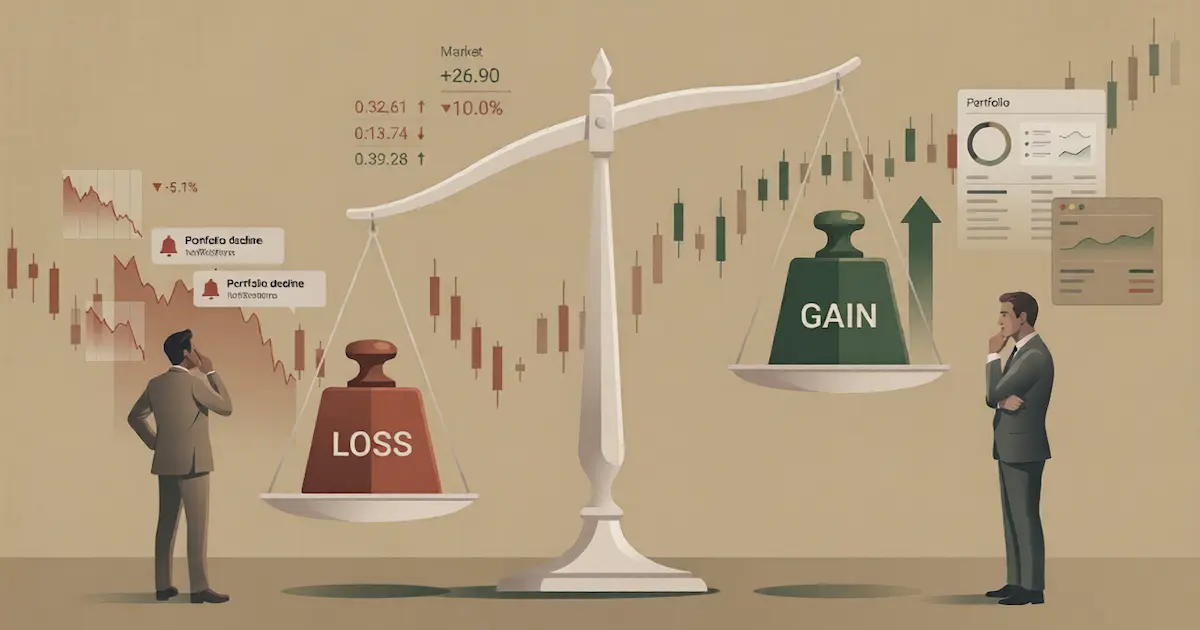
Loss aversion is feeling losses about twice as intensely as equal gains. The 2.25 ratio, examples, loss vs risk aversion, and how it quietly hurts returns.
14 min read

Herd mentality in investing is copying the crowd instead of your own analysis. How it works, the India and US bubbles, what it costs, and how to spot it.
13 min read
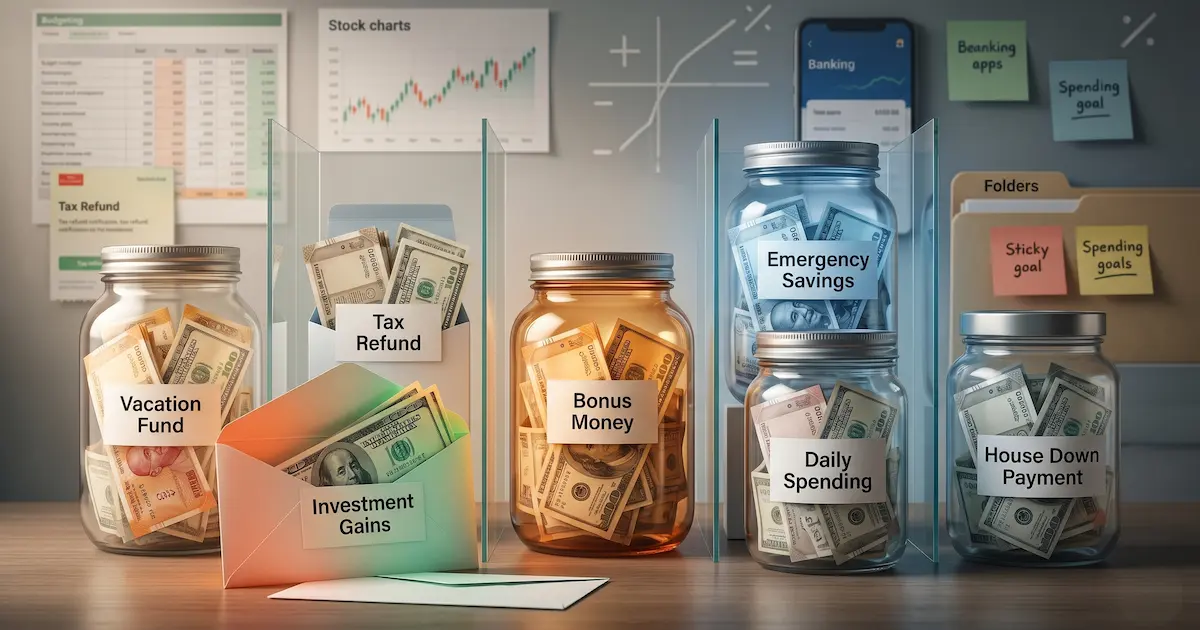
Mental accounting is why a bonus feels different from salary, though every rupee spends the same. Real examples, the investing trap, and how to beat it.
12 min read