Loan Against Property: The Risk and the Tax Catch

By Tapabrata Biswas · Published September 3, 2026 · 13 min read
Researched with AI assistance, reviewed and edited by Tapabrata Biswas.
Reviewed by Subir Kumar Debsharma, Tax, GST and ROC professional with 20+ years of experience.

Search for a loan against property and count the independent voices. There are none. Every organic result on the first page belongs to a bank or a housing finance company, and the sponsored ones belong to two more.
That's not a complaint about them. It's the reason this post exists.
One of those ranking pages, from a housing finance company, tells readers the loan can be used "for any purpose of your choice from paying debts to going on a vacation." It's true. It also never mentions that a holiday spent on borrowed money earns no tax deduction, or that the security behind the loan is the reader's house and can be taken without a court hearing. Neither of those is a secret. They're just not things a lender's own page has any reason to lead with. This is an explainer rather than advice, and whether the loan suits you is a question for a qualified adviser who can see your position.
What is a loan against property?
A loan against property is a secured loan in which you mortgage a residential or commercial property you already own, and the lender holds that property as security until the debt is repaid.
The structure explains everything else about it. Because the lender holds real security, the rate is lower than an unsecured personal loan of the same size, the tenure is longer, and the sanctioned amount can be much larger. The same security is why default has consequences a personal loan doesn't carry.
Lenders describe the money as unrestricted, and for their purposes it is. You aren't required to spend it on the property. That freedom is genuine, and it's also the thing that quietly decides the tax question further down this page.
What happens if you don't pay?
The lender can take possession of the property and sell it without first obtaining a court decree, under the SARFAESI Act.
This is the part missing from every lender page checked for this article, and it isn't a small omission. Ordinary unsecured debt requires the creditor to sue, win, and then execute. A mortgage under SARFAESI skips that.
The sequence runs like this. The account has to be classified a non-performing asset first, which normally means 90 days overdue. The lender then issues a demand notice under Section 13(2) calling on the borrower to discharge the whole debt within 60 days. The borrower may object, and Section 13(3A) requires the lender to consider that representation and pass an order within 15 days. The clock keeps running while that happens. If the debt is still unpaid when the 60 days end, Section 13(4) permits the lender to take possession of the secured asset, take over its management, or sell it.
A challenge goes to the Debt Recovery Tribunal under Section 17, and the window is 45 days from the measure complained of. Beyond that you're asking the tribunal to condone the delay.
The Act does not reach everything. It excludes agricultural land, debts not exceeding ₹1 lakh, and cases where the amount due is less than 20% of the principal and interest. A loan against a house for lakhs or crores sits well inside its scope.
Worth being precise about what this does and doesn't mean. It isn't a prediction that anyone will lose their home, and lenders generally prefer repayment to enforcement, which is slow and expensive for them too. It's a statement about which remedy exists. The rate on a loan against property is lower precisely because that remedy exists, so the cheaper rate and the enforcement power are the same fact seen from two sides.
Is the interest tax deductible?
Only where the borrowed money went into the property itself, and end use is written into the statute itself.
Section 22(1)(b) of the Income-tax Act 2025 allows, in computing income from house property, "where the property has been acquired, constructed, repaired, renewed or reconstructed with borrowed capital, the amount of any interest payable on such capital". Six verbs, all of them about the property. A loan against property spent on a wedding, a holiday, a medical bill or a child's fees earns nothing under this head, however real the expense. Where the money went into a business, the question moves to business expenditure and a different set of rules.
The tax-focused pages on this search do get that much right. What none of them carries is the next two conditions, and between them they decide whether the deduction exists at all.
The default regime removes it for a self-occupied house. Section 202(2)(a)(v) computes total income under the new regime without the deduction under Section 22(1)(b) "in respect of properties referred to in section 21(6)", and Section 21(6) is the provision that treats a house as self-occupied. The new regime has been the default since FY 2023-24, so for most filers the deduction on their own home is already gone unless they actively opt out. That's the same structure that catches the education loan deduction, and what claiming Section 80E actually costs works through what opting out is worth.
A let-out property is treated differently, and better. The exclusion in Section 202(2)(a)(v) is limited to Section 21(6) properties. Interest on a let-out house therefore survives the default regime. It also escapes the ₹2 lakh ceiling, because Section 22(2) applies that cap only to properties referred to in Section 21(6). So the deduction that most people assume is capped at ₹2 lakh is uncapped on a let-out property and absent on a self-occupied one in the default regime, which is close to the opposite of the common understanding.
Two smaller conditions sit inside Section 22(2) and are worth knowing before relying on the ₹2 lakh figure at all. The acquisition or construction has to be completed within five years from the end of the tax year in which the capital was borrowed, and the borrower has to furnish a certificate from the person to whom the interest is payable.
Three conditions stacked in prose are hard to hold, so the same thing as one table.
| Situation | Deduction under the default regime | Under the old regime |
|---|---|---|
| Money spent on the property, self-occupied | none, per s.202(2)(a)(v) | up to ₹2,00,000, per s.22(2) |
| Money spent on the property, let out | full interest, uncapped | full interest, uncapped |
| Money spent on a wedding, holiday or medical bill | none | none |
| Money spent on a business | not under this head, business rules apply | not under this head |
Returns for FY 2025-26 are still filed under the Income-tax Act 1961, where these provisions are Sections 24(b), 23(2) and 115BAC, and the two regimes' rates are set out in the income tax slabs explainer. The substance is the same and the numbering is not, which is why both appear here. Any of this is worth confirming with a chartered accountant against your own end-use documentation, because proving where the money went is the borrower's job.
How much can you actually borrow?
Less than the property is worth, and the percentage matters less than the valuation it is applied to.
Published loan-to-value ratios sit broadly between 50% and 75% across lenders, and the AI-generated summary at the top of this search quotes 50% to 85% of market value. Then look at what an individual lender writes. Indian Overseas Bank states 40% of the forced sale value of the property.
Those two numbers are not comparable, and the difference isn't the percentage. Forced sale value assumes a quick disposal and sits below open market value by design. A lender offering 60% of market value and one offering 40% of forced sale value are describing different things, and the second is a good deal more conservative than the gap between 60 and 40 suggests. When two sanction letters disagree by more than you expected, the valuation basis is usually where it happened.
Income does its own work on top. Lenders test what proportion of your income already goes to fixed obligations, so a valuable property held by a borrower with existing loans can produce a smaller sanction than the loan-to-value ratio implies. The binding constraint is whichever of the two bites first, and it is not always the one people expect.
How does it compare with the alternatives?
A loan against property is cheaper than a personal loan and more expensive than a home loan, and the ordering follows the security in each case.
| Security | Typical use | What default reaches | |
|---|---|---|---|
| Home loan | the property being bought | buying that property | the property |
| Loan against property | a property you already own | unrestricted | the property you already own |
| Personal loan | none | unrestricted | a court judgment first |
The comparison people find hardest is the middle row against the bottom one, because the two feel similar: money you can spend on anything. The difference is entirely in the last column. A personal loan of ₹20 lakh and a loan against property of ₹20 lakh carry different rates because they carry different consequences, and the rate gap is the price of that difference rather than a discount anyone is offering.
Against a home loan, the distinction is what the money buys. A home loan is money for the property it is secured on, which is why its interest sits inside the same Section 22(1)(b) treatment automatically. A loan against property only lands there if the borrower chooses to spend it on the property.
What this post deliberately does not cover
It doesn't say whether to take one. That turns on your income stability, your existing obligations, what the money is for and what happens to your household if the security is enforced, and none of that is visible from here.
It doesn't publish interest rates or compare lenders. Rates move with each lender's benchmark and with the borrower's profile, so a table of them is out of date the week it's written, and it is the one thing every page on this search already provides.
It doesn't cover the procedure for challenging enforcement. A Section 17 application to the Debt Recovery Tribunal is litigation with a 45-day limit, and it belongs with an advocate.
It doesn't cover loans against commercial or industrial property in any depth, lease rental discounting, or overdraft facilities secured on property, all of which behave differently from the residential case described here.
Frequently asked questions
Is it a good idea to take a loan against property?
That depends on facts only you and a qualified adviser can see, and this post deliberately does not answer it. What can be said is what makes the decision different from other borrowing. A loan against property is cheaper than a personal loan because the lender holds security, and the security is usually the house you live in. The trade you are making is a lower interest rate for the risk of losing the home, and enforcement on that security does not require the lender to go to court first. Anyone weighing it should price the rate saving against that, and read the sanction letter's default clauses rather than the marketing page.
What happens if I default on a loan against property?
The lender can take possession of the property and sell it without obtaining a court decree. The sequence is set by the SARFAESI Act. The account must first be classified as a non-performing asset, which normally means 90 days overdue. The lender then issues a demand notice under Section 13(2) giving 60 days to pay the whole outstanding debt. You may make a representation, and the lender has to consider it and pass an order within 15 days under Section 13(3A), but that does not pause the 60 days. If the debt is unpaid when the period expires, Section 13(4) allows the lender to take possession of the asset, manage it, or sell it. A challenge lies to the Debt Recovery Tribunal under Section 17, within 45 days of the measure.
Is loan against property interest tax deductible?
Only in specific circumstances, and the marketing pages tend to state the benefit without the conditions. Under Section 22(1)(b) of the Income-tax Act 2025, interest on borrowed capital is deductible from income from house property where the property has been acquired, constructed, repaired, renewed or reconstructed with that capital. End use is written into the provision, so a loan against property spent on a wedding, a holiday or medical bills earns no deduction under this head however genuine the expense. If the money went into a business, the deduction question moves to business expenditure instead. This is worth confirming with a chartered accountant before you rely on it.
Does the new tax regime allow the loan against property interest deduction?
For a self-occupied house, no. Section 202(2)(a)(v) of the Income-tax Act 2025 computes total income under the default regime without the deduction under Section 22(1)(b) in respect of properties referred to in Section 21(6), and Section 21(6) is the self-occupied provision. Since the new regime has been the default since FY 2023-24, the deduction on a self-occupied house is unavailable unless you actively opt out. A let-out property is treated differently, because the exclusion is limited to Section 21(6) properties, so interest on a let-out house remains deductible and is not subject to the ₹2 lakh ceiling that applies to self-occupied ones.
How much loan can I get against my property?
Less than the property is worth, and often less than the headline percentage suggests, because the percentage is applied to a valuation the lender controls. Published loan-to-value ratios sit broadly between 50% and 75% of value across lenders. The figure that matters is which value. Indian Overseas Bank, for example, states 40% of the forced sale value of the property, and forced sale value is deliberately lower than open market value because it assumes a quick sale. Two lenders quoting similar percentages against different valuation bases will sanction very different amounts, so the valuation basis is the number worth asking about.
In summary
The lower rate on a loan against property and the lender's power to take the house are not two separate facts to weigh against each other. They're one fact. The rate is lower because the remedy is stronger, and a borrower who understands only the first half has priced the loan wrong. The tax benefit, meanwhile, is real but conditional three times over: on where the money went, on whether the house is let out, and on which regime you file under. Work out which of those you actually satisfy before counting the deduction as part of the cost.
Sources
- Income-tax Act, 2025, Income Tax Department. Sections 21(6), 22(1)(b), 22(2) and 202(2)(a)(v) are quoted in this post from the Act as published in the Gazette of India
- The Securitisation and Reconstruction of Financial Assets and Enforcement of Security Interest Act, 2002 (Act 54 of 2002), for Sections 13, 17 and 31. The bare Act is hosted on India Code, the government repository of central legislation, and administered by the Department of Financial Services
- Reserve Bank of India, for the classification of an account as a non-performing asset, which is the precondition to a Section 13(2) notice
- Indian Overseas Bank, loan against property, for the 40% of forced sale value figure and the 12 to 180 month tenure quoted above
- Income Tax Department, new regime and old regime FAQs, for the default status of the new regime



You might also like

RBI barred pre-payment charges on loans sanctioned from 1 January 2026, but only on floating-rate loans. Most personal loans are fixed, so check which you hold.
14 min read
Section 80E has no upper limit, which is the part everyone quotes. It also sits outside the default tax regime, so on ₹15 lakh income claiming it can cost ₹66,300 more than skipping it.
12 min read
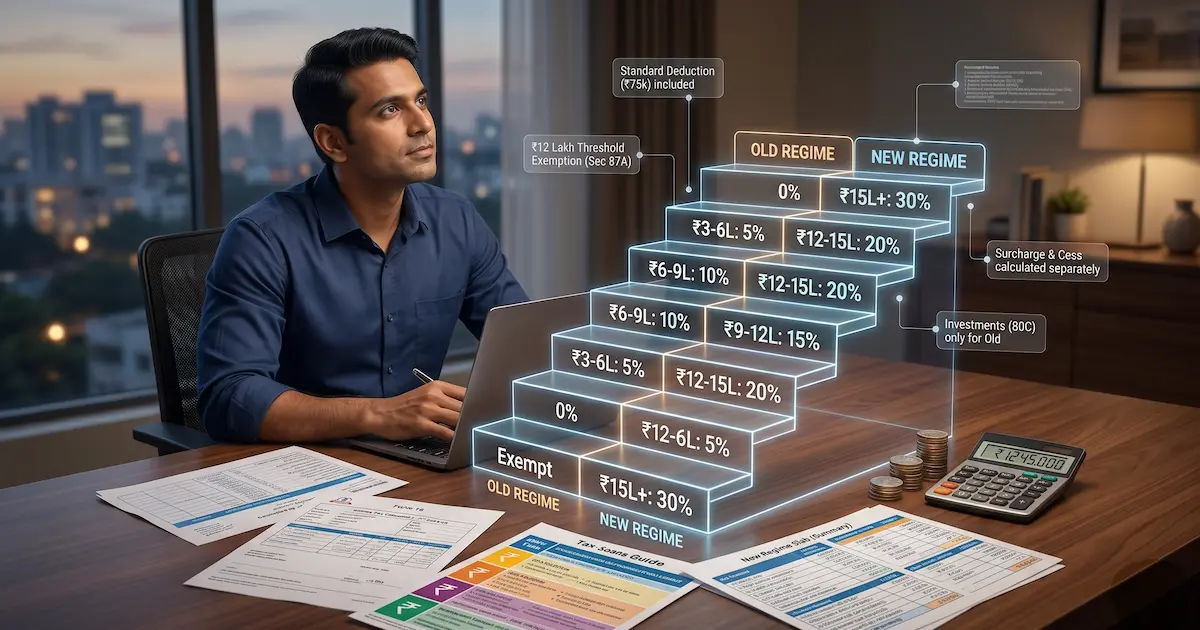
Income tax slabs in India for FY 2025-26 (AY 2026-27): new and old regime rates, the ₹12.75 lakh salaried zero-tax point, the 87A rebate, surcharge, and cess.
13 min read