How Credit Card Interest Works: The India & US Math

By Tapabrata Biswas · Updated July 7, 2026 · 13 min read
Researched with AI assistance, reviewed and edited by Tapabrata Biswas.
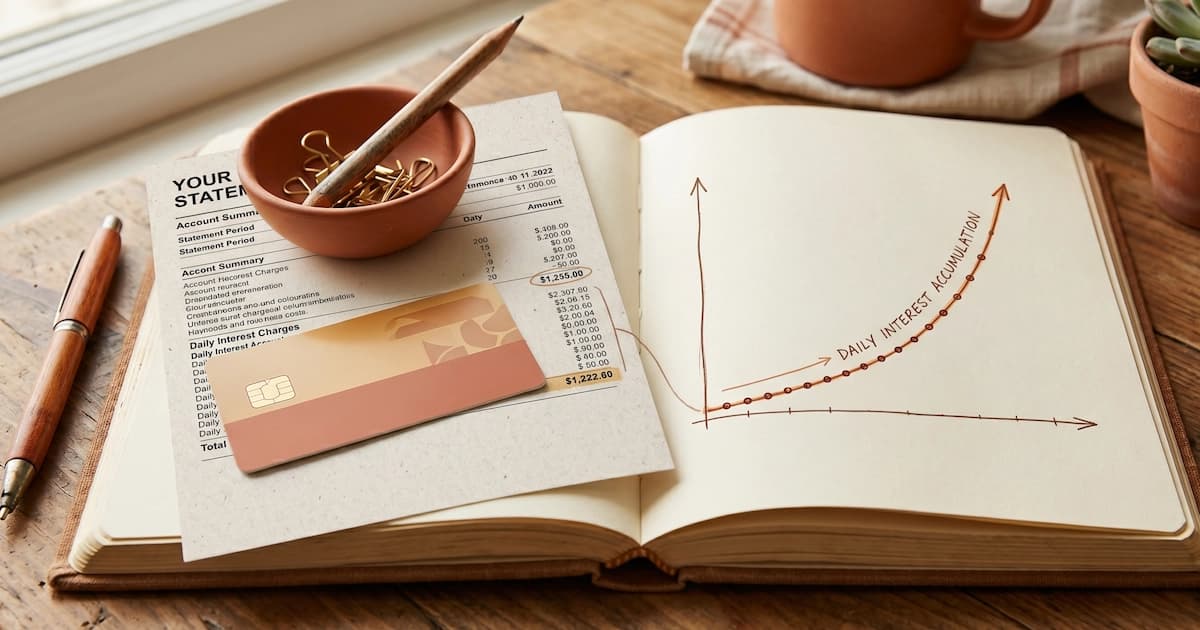
US consumers were charged $160 billion in credit card interest in 2024, up from $105 billion just two years earlier, according to the Consumer Financial Protection Bureau's December 2025 market report. Almost none of it was unavoidable. A credit card has only two clean states: pay the full statement balance every month and pay nothing in interest, or carry a balance and pay interest on almost everything, sometimes at 40% a year or more.
This guide walks through the machinery between those two states. How the daily rate is built from the APR, what the average daily balance method actually computes, when the grace period protects you and when it vanishes, and why the minimum payment is designed to keep you paying for a decade. The math is shown in both rupees and dollars, because the Indian and US models look different on the surface and identical underneath.
How does credit card interest work?
Credit card interest is the charge for borrowing money on the card, and it applies only when you carry a balance past the grace period. It exists at all because a credit card borrows, which is the line that separates it from a debit card. Spend on the card, pay the full statement balance by the due date, and a normal purchase costs you nothing, because the grace period covers it. Leave any part unpaid and the issuer starts charging interest on it, every single day, until it is gone.
The rate is quoted as an annual figure, the APR, but it is never applied once a year. It is sliced into a daily rate and charged on your balance day by day, which is the detail that trips most people up. Our APR vs interest rate explainer covers why the two terms are not quite the same thing; for interest here, the APR is the number that gets divided down.
One more mechanism matters: the interest compounds. Today's unpaid interest is added to the balance, and tomorrow's interest is calculated on that slightly larger number. The same force that makes compound interest a gift to savers makes it a slow bleed for anyone revolving a card balance.
How is credit card interest calculated?
Issuers calculate credit card interest with the average daily balance method: they add up your balance at the end of every day in the billing cycle, divide by the number of days to get the average, then apply a daily rate. That daily rate, the daily periodic rate, is simply the APR divided by 365.
Take a 24% APR card. The daily periodic rate is 0.24 divided by 365, which is 0.0657% a day. Carry a flat $1,000 balance for a 30-day cycle and the interest is $1,000 times 0.000657 times 30, about $19.73. Let the interest compound daily and not charging it as a flat sum and the figure is $19.92. That 19-cent gap is the whole of what "compounded daily" means in practice, and almost no explainer bothers to show it.
The average part matters when the balance moves mid-cycle. Say you hold $1,000 for the first 10 days, then a $500 purchase posts and you sit at $1,500 for the remaining 20 days. Add each day's balance and you get (10 times $1,000) plus (20 times $1,500), which is $40,000. Divide by 30 days and the average daily balance is $1,333.33. The interest for the cycle is $1,333.33 times 0.000657 times 30, about $26.30. The method captures the days your balance was higher, which is exactly why a mid-cycle payment, made a few days earlier, shaves the charge down.
| Cycle scenario (24% APR, 30 days) | Average daily balance | Interest for the cycle |
|---|---|---|
| $1,000 held flat | $1,000.00 | $19.73 |
| $1,000, then $1,500 from day 11 | $1,333.33 | $26.30 |
| $1,000 flat, compounded daily | $1,000.00 | $19.92 |
Why Indian cards feel so much more expensive
Indian credit cards quote interest as a monthly rate, not an annual one, and the typical 3.5% to 3.75% a month works out to roughly 42% to 45% a year. That single framing difference is why an Indian card can quietly cost three to four times what a personal loan does. As of 2025-26, SBI Card charges up to 3.75% a month on unsecured cards (45% a year), HDFC Bank up to 3.6% (43.2%), and ICICI Bank around 3.75%, per each issuer's schedule of charges.
The formula Indian issuers publish looks different from the US daily rate but does the same job:
Interest = (number of days since the transaction, times the outstanding amount, times the monthly rate, times 12) divided by 365.
Run ₹10,000 through it. You spend ₹10,000, pay nothing by the due date, and clear it 30 days later at 3.5% a month. The interest is (30 times 10,000 times 3.5% times 12) divided by 365, which comes to ₹345. Then 18% GST rides on top of every finance charge in India, taking it to about ₹407. Leave that ₹10,000 unpaid for a full year and monthly compounding pushes the real cost past ₹5,000, so you would owe more than half again what you spent.
The other Indian catch is that interest runs from the transaction date, not the due date, the moment you lose the interest-free period. Pay ₹500 of a ₹1,100 bill and the issuer charges interest on the original ₹1,100 from the day each purchase posted, including the ₹500 you did pay, because clearing less than the full amount forfeits the grace period on everything. The exact monthly rate and formula for any card sit in its Most Important Terms and Conditions, which the Reserve Bank of India's card operations directions require every issuer to disclose.
What is a credit card grace period?
A grace period is the window between the statement closing date and the payment due date during which new purchases carry no interest, as long as the previous statement was paid in full. In the US, the CARD Act of 2009 sets a minimum of 21 days. In India, the RBI mandates at least 15 days, and most cards advertise a 20-to-50-day interest-free window depending on where in the billing cycle the purchase falls.
Two rules govern whether the grace period is actually working for you.
It covers purchases only. Cash advances and balance transfers get no grace period at all, so interest starts from the transaction date. That is a genuinely separate trap, covered below.
It disappears the instant you carry a balance. Pay in full one month and miss it the next, and interest starts on the unpaid portion and on every new purchase from its transaction date. At most issuers the grace period only comes back after you pay the full statement balance for a couple of consecutive cycles. This is also why a small charge can appear even after you clear the full balance, the residual interest that accrued between the statement date and the day your payment landed while you were still carrying debt.
Do you get charged interest if you only pay the minimum?
Yes: the minimum payment keeps your account current and dodges the late fee, but interest keeps accruing daily on everything you did not pay. The minimum is usually set at 2% to 5% of the balance, with a floor near ₹500 in India or $25 to $35 in the US, and it is sized to be painless to pay and slow to clear.
Watch a ₹1,00,000 balance at 42% a year, paid at the 5% minimum of ₹5,000 in month one. The first month's interest is roughly ₹1,00,000 times 42% divided by 12, about ₹3,500. So of that ₹5,000 payment, ₹3,500 is interest and only ₹1,500 touches the principal. Because the minimum is a percentage of a shrinking balance, the rupees going to principal get smaller every month. At the 5% minimum, clearing ₹1,00,000 takes well over a decade and costs more in interest than the original purchase.
The US version behaves the same way. A $5,000 balance at 22% APR paid at a 2% minimum of $100 sends about $91.67 to interest in month one and $8.33 to principal. At that pace the balance takes roughly 30 years to clear. To put your own numbers against this, our credit card interest calculator shows the payoff time and total interest at your payment beside the minimum-only path, in rupees or dollars.
Why cash advances are the most expensive way to use a card
A cash advance, withdrawing cash against your credit card, has no grace period, so interest accrues from the transaction date, and in India it comes bundled with a fee and GST on top. There is no window in which the cash is free. The meter starts the moment the notes leave the ATM.
In India the fee is typically 2.5% to 3.5% of the amount withdrawn, with a minimum around ₹500, and then 18% GST applies to both the fee and the interest. Withdraw ₹10,000 and you are down roughly ₹590 in fee and GST before a single day of interest, which itself runs at the full 3.5%-plus monthly rate from day one. US cards handle it similarly, usually at a higher cash advance APR than the purchase rate, commonly in the high 20s, plus a fee of around 3% to 5%. A cash advance is, in effect, an unsecured loan priced at the worst rate the card offers, which is why it belongs in the emergency-only category rather than routine use. Converting a large purchase to an instalment plan runs far cheaper than either a cash advance or a revolving balance; our credit card EMI calculator shows that cost across tenures, including the 18% GST.
How do you avoid paying credit card interest?
The only way a normal purchase carries zero interest is to pay the full statement balance by the due date, every cycle, which keeps the grace period alive. That is the whole mechanism. There is no partial version of it: paying 90% of the statement still forfeits the interest-free period on the remaining 10% and on the next cycle's purchases.
Everything else is a consequence of that one rule. Keeping the balance at zero means the daily periodic rate never touches your money, however high the APR happens to be. Carrying even a small balance flips the card into its expensive state, where interest runs daily on the average balance and compounds. The rate on the card matters enormously once you revolve a balance and barely at all if you never do, which is why the headline APR is the wrong number to obsess over and the statement balance is the right one to watch.
What this guide does not cover
This guide explains how credit card interest is calculated and when it applies; it is not advice about your specific card or debts. It does not recommend a particular card, tell you how to prioritise your own repayments, or cover balance-transfer offers, reward-point maths, or the credit-score effects of a carried balance (for that last one, see what is credit utilization). Rates and fees are issuer-specific and change, so the exact figures for your card live in its cardholder agreement or Most Important Terms and Conditions. For a broader grounding, our explainer on what an interest rate is sits underneath all of this.
Frequently asked questions
How does credit card interest work? Credit card interest is a charge for borrowing, applied only when you carry a balance past the grace period. The card's APR is divided by 365 to get a daily rate, which is applied to your average daily balance every day and posted once per billing cycle. Pay the full statement balance by the due date and a normal purchase costs zero interest, because the grace period covers it. Carry any balance and interest accrues daily on what you owe, including on new purchases, until it is cleared.
How is credit card interest calculated? Issuers use the average daily balance method: they add up your balance at the end of each day in the cycle, divide by the number of days to get the average daily balance, then multiply by the daily periodic rate (APR divided by 365) and the number of days. A US$1,000 balance held all cycle at 24% APR costs about $19.73 over 30 days. Indian issuers quote a monthly rate instead and use the formula (days times amount times monthly rate times 12) divided by 365.
Do you get charged interest if you only pay the minimum? Yes. Paying the minimum keeps the account current and avoids a late fee, but interest keeps accruing daily on the rest of the balance. On a ₹1,00,000 balance at 42% a year, roughly ₹3,500 of the first month's payment is interest, so the principal barely moves. The minimum is usually set at 2% to 5% of the balance precisely so the debt revolves for years rather than clearing.
Why am I still charged interest after paying my balance in full? This is residual or trailing interest. If you carried a balance last cycle, interest kept accruing every day between the statement date and the day your payment landed, so a small charge appears on the next statement even though the statement balance shows paid. It usually clears after one more full-payment cycle. It only happens when the grace period was already lost, never on an account paid in full every month.
Why do cash advances have no grace period? A cash advance, withdrawing cash against your card, is treated as an immediate loan, so interest accrues from the transaction date with no interest-free window at all. In India there is also a cash advance fee of about 2.5% to 3.5% of the amount, with a minimum near ₹500, plus 18% GST on both the fee and the interest. A ₹10,000 ATM withdrawal starts costing money the moment it leaves the machine.
What is a good credit card interest rate right now? In the US, the Federal Reserve's G.19 release put the average rate on accounts assessed interest at about 21.5% in early 2026, while new-card offers averaged about 23.8% (LendingTree). In India, most cards sit at 3.5% to 3.75% a month, roughly 42% to 45% a year. Any purchase rate is largely irrelevant if you pay in full each month, because the grace period means you are charged nothing.
In summary
Credit card interest is charged daily, applied to the average daily balance, and compounded, so the effective rate runs a little above the headline APR and a lot above what most people expect. The grace period is the only mechanism that lets you use a card without paying interest, and it survives only on a statement paid in full. Indian cards hide the sting in a monthly rate that annualizes to 42% or more, and cash advances strip away even the grace period. The number that decides whether any of this costs you a rupee or a dollar is not the APR on the card. It is the balance you leave unpaid when the statement closes.
The next read in this series is what happens if you stop paying credit card debt entirely, the 30/60/90/180-day delinquency timeline through charge-offs and collections. After that, how long it actually takes to pay off credit card debt walks through minimum, fixed, and avalanche payoff math side by side.
Sources
- Consumer Financial Protection Bureau, The Consumer Credit Card Market (December 2025), consumerfinance.gov
- Federal Reserve, G.19 Consumer Credit Release (credit card plan rates), federalreserve.gov/releases/g19/current
- Reserve Bank of India, Master Direction on Credit Card and Debit Card Operations, rbi.org.in
- SBI Card, Most Important Terms and Conditions (monthly rate and cash advance charges), sbicard.com
- Consumer Financial Protection Bureau, Regulation Z / Truth in Lending (grace period and billing rules), consumerfinance.gov/rules-policy/regulations/1026

You might also like

APR is the rate plus fees, but the rules exclude a specific list. What India's Key Facts Statement requires, and why credit cards sit outside it.
16 min read

Compound interest is interest earned on interest. The formula, worked rupee examples, and why compounding daily instead of yearly is worth far less than you think.
10 min read
Indian floating-rate bank loans must reset at least once every three months under an RBI rule. What sets your rate, and which benchmark it is tied to.
16 min read